
Body composition, measured to the limb.
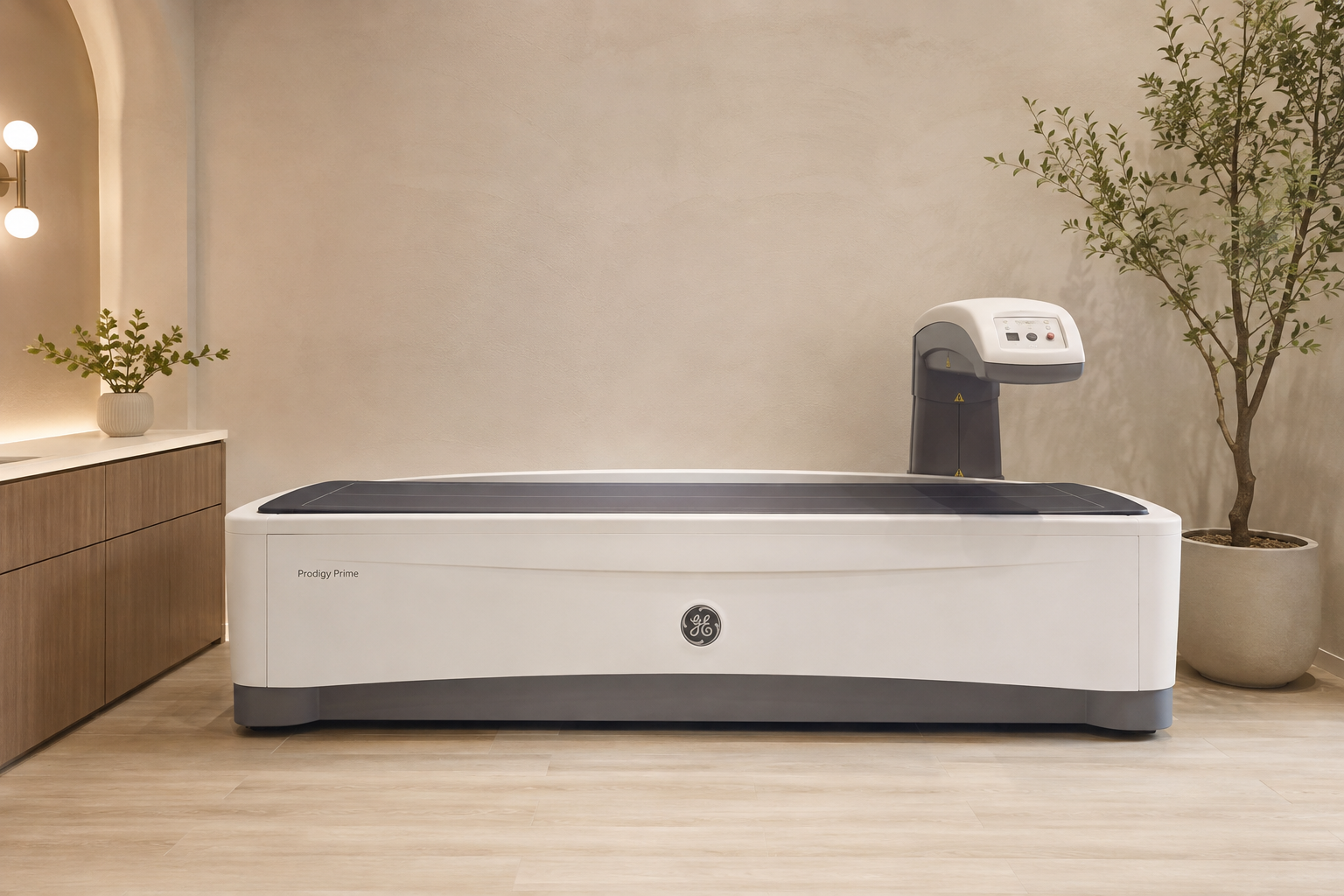
A DEXA scan passes two low-dose X-ray energies through you and separates what it finds into fat, lean tissue, and bone mineral — region by region. It's the method research uses when the answer has to be right, and it takes about ten minutes on the table.
- 10 min on the table
- No needles, no gown
- Report read to you
What comes out of it
Lean mass, region by region
Left arm, right arm, trunk, left leg, right leg. This is where asymmetry shows up, and it's what tells you whether a training block did what you hoped.
Fat mass and distribution
Total body fat as a percentage, plus where you carry it. Android-to-gynoid ratio gets at the pattern that matters metabolically.
Visceral adipose tissue
The fat around your organs, estimated directly rather than inferred from waist size. It's the reading most closely tied to metabolic risk, and it often moves before total weight does.
Bone mineral density
A T-score comparing you to a young-adult reference, and a Z-score against your own age group. This is the same measurement used clinically to assess osteopenia and osteoporosis risk.
Why the same measurement answers very different questions
If you're lifting, the useful column is regional lean mass. Two years of training can produce a total-weight change of almost nothing while your legs add four pounds of muscle and your trunk loses three pounds of fat. That's a good year, and only DEXA will tell you it happened.
If you're on a GLP-1 or in a deficit, the useful column is the ratio. Weight loss is never purely fat, and the share that comes from lean tissue is the part worth managing — with protein, with resistance work, and with a scan before and after so it isn't guesswork.
If you're past forty-five, the useful column is bone. Density declines quietly for years before anything announces it, and a T-score at fifty is worth far more than a first one at sixty-five, because it gives your physician a trend rather than a snapshot.
Same ten minutes on the table. Different pages of the report matter to each of you, which is why we read it back to you rather than emailing a PDF and wishing you luck.
Precision, and what it means for your follow-up
The honest version: DEXA is precise, not infinitely precise. Knowing the margin is what makes repeat scans useful instead of maddening.
Typical short-term precision error for whole-body fat percentage on a well-calibrated scanner with consistent positioning.
The soonest a body composition change is usually larger than the measurement noise. Sooner than that and you're reading hydration.
The interval for bone density. Bone remodels slowly, and a shorter gap tells you almost nothing you can act on.
Same machine, same protocol, similar time of day, similar hydration. That's how we keep your second scan comparable to your first. More on the method.
Add RMR
Composition tells you what changed. Resting metabolic rate tells you the budget you're working with. Together they're the standard opening for a fat-loss phase.
Book both — $198Add VO₂ max
Structure plus engine. If you're training for something specific, this is the pair that gives you both what you're carrying and what you can do with it.
Book both — $198All three
Ninety minutes, one debrief that ties the readings together. The most complete baseline we offer, and the one worth repeating annually.
Book the full panel — $297